What are Rubrics?
A rubric is a scoring tool that explicitly represents the performance expectations for an assignment or piece of work. A rubric divides the assigned work into component parts and provides clear descriptions of the characteristics of the work associated with each component, at varying levels of mastery. Rubrics can be used for a wide array of assignments: papers, projects, oral presentations, artistic performances, group projects, etc. Rubrics can be used as scoring or grading guides, to provide formative feedback to support and guide ongoing learning efforts, or both.
Have you used a rubric for an assignment in the past? Many faculty have said that rubrics are not only a real time saver, but they provide guidance on grading fairly. If you have a stack of 30 exams or papers to grade, it can be very tiring! Your eyes might begin to blur after about 20 - and grading fairly AND consistently is important in your classes! Rubrics are very easy to set up in Canvas, too. You can always ask your Instructional Designer to help you get started. And, in Canvas, once you create a rubric template you will be able to re-use it! Here's an example of a rubric.
A Google search will provide many, many examples of rubrics. Here's a good way to start: choose one assignment to start and think about how you have graded it in the past. Can you remember what an A+ paper looks like? How about a B? And so on. Then look at a sample rubric in your discipline. Remember, you can always ask a department colleague if they would share an example! Think about what kind of writing, computation, or behavior you want to see in this assignment. Also think about what an acceptable answer is, and then assign some points to each of those levels. A description explaining how a student earns those points will help students understand their grade. It's important to give students the rubric along with the assignment so they know what the expectations are.
And when students have the rubric with clearly outlined expectations you will get fewer questions like, "Why did I only get a C on this assignment?" For that reason alone, rubrics are a good idea!
Remember to check in with a mentor or your faculty development person or the Instructional Designer on your campus for ore information about creating and using a rubric!
From: https://www.cmu.edu/teaching/designteach/teach/rubrics.html
Tuesday, August 16, 2016
Tuesday, August 9, 2016
Summer Reading 2016: Week 2
Summer Reading Week 2
Join us as we continue reading this summer! Check the Summer Reading page for a recap.Grit: The Power of Passion and Perseverance by Angela Duckworth
In her late twenties, Angela left a demanding job as a management consultant to teach math to seventh graders in the New York City public schools. Several years in the classroom taught her that effort was tremendously important to success. To begin to solve the mystery of why some people work so much harder and longer than others, Angela entered the PhD program in psychology at the University of Pennsylvania, where she is now a professor. She is also a 2013 MacArthur fellow and founder and scientific director of the Character Lab.
Amazon’s description: In this instant New York Times bestseller, pioneering psychologist Angela Duckworth shows anyone striving to succeed—be it parents, students, educators, athletes, or business people—that the secret to outstanding achievement is not talent but a special blend of passion and persistence she calls “grit.”
Drawing on her own powerful story as the daughter of a scientist who frequently noted her lack of “genius,” Duckworth, now a celebrated researcher and professor, describes her early eye-opening stints in teaching, business consulting, and neuroscience, which led to the hypothesis that what really drives success is not “genius” but a unique combination of passion and long-term perseverance.
In Grit, she takes readers into the field to visit cadets struggling through their first days at West Point, teachers working in some of the toughest schools, and young finalists in the National Spelling Bee. She also mines fascinating insights from history and shows what can be gleaned from modern experiments in peak performance. Finally, she shares what she’s learned from interviewing dozens of high achievers—from JP Morgan CEO Jamie Dimon to New Yorker cartoon editor Bob Mankoff to Seattle Seahawks Coach Pete Carroll.
Among Grit’s most valuable insights:
- Why any effort you make ultimately counts twice toward your goal
- How grit can be learned, regardless of I.Q. or circumstances
- How lifelong interest is triggered
- The magic of the Hard Thing Rule
- How much of optimal practice is suffering and how much ecstasy
- Which is better for your child—a warm embrace or high standards
Winningly personal, insightful, and even life-changing, Grit is a book about what goes through your head when you fall down, and how that—not talent or luck—makes all the difference.
"Angela Duckworth [is] the psychologist who has made 'grit' the reigning buzzword in education-policy circles...Duckworth's ideas about the cultivation of tenacity have clearly changed some lives for the better...In this book, Duckworth, whose TED talk has been viewed more than eight million times, brings her lessons to the reading public."
—Judith Shulevitz, The New York Times Book Review
"It really isn't talent but practice—along with passion—that makes perfect, explains psychologist Duckworth in this illuminating book. Inspiration for non-geniuses everywhere."
—People
“Psychologists have spent decades searching for the secret of success, but Angela Duckworth is the one who found it. In this smart and lively book, she not only tells us what it is, but also how to get it.”
—Daniel Gilbert, author of Stumbling on Happiness
Want to learn more? http://angeladuckworth.com/
I first became aware of the work by Angela Duckworth in the summer of 2015. I was hosting a campus book club and we were reading the book Growth Mindset by Carol Dweck. The material inspired one of the faculty to do some more research into the topic and her research led her to Angela Duckworth’s work. At the time we had mostly online resources to read and look at, and we spent quite a lot of time reviewing her work and watching her TED talk. I should note that Duckworth does NOT claim that grit is the only key to success (as some may believe). There are many factors that go into being successful (whether as a student, a West Point cadet during Beast Week, or Seahawks coach Pete Carroll). We were so excited about the book that several of us got on the wait list for Grit!
Book club questions:
2. Watch this short video on the Money website: http://time.com/money/4380504/grit-in-workplace/. Which of the 4 things to be grittier are you willing to work on?
3. Read this article from Forbes online: The secret ingredient of successful people and organizations-grit. What is the “Hard Thing Rule” that Duckworth developed for her family, and do you buy into that? Can you see yourself practicing this with your family/students/yourself?
4. Here’s a great Op-Ed article from the New Your Times by David Brooks: putting grit in its place. Do you agree with Brooks when he says, “In life we want independent thinking and risk-taking, but the G.P.A. system encourages students to be deferential and risk averse, giving their teachers what they want”? How do you feel about de-emphasizing the GPA?
5. And here’s one of my favorite articles from the New York Times: Secret to Success - Failure. What do you think of the idea of a “character report card”?
Other related books (from Amazon)
Grit to Great: How Perseverance, Passion, and Pluck Take You from Ordinary to Extraordinary by Linda Kaplan Thaler
Monday, August 1, 2016
5 Things To Do NOW to Prepare for Fall Quarter
As the Summer Quarter begins to wind down, it's time to start thinking about Fall Quarter! Surely, this doesn't mean you shouldn't continue to enjoy the gorgeous weather, vacations, tending your gardens, reading and relaxing, but now is a great time to start planning ahead for September!
Here are 5 things you can (and should) do to prepare now for Fall Quarter:
1) Find out when your first Department meeting is! Plan to attend, and maybe even bring some treats to share! (Food is always a great ice breaker.) It's important that you connect with your colleagues in your Department and Division. They can help guide you through your first quarter, and give you hints about how to be successful!
2) Do you have your syllabi ready? If you are using a syllabus that someone else in the department shared with you, make sure you review carefully for things like grading policies and scale, office hours, and schedule for exams. It's okay to make changes, even small ones, so that you feel comfortable with this "contract" with students (btw, this is not a legal contract!)
3) Do you have all the materials you need for the first day and the first week of class? Textbook? White board markers? Other materials? Don't wait until the first day - running around campus trying to find things that day can be exhausting!
4) Do you have a plan for the first 5 minutes of class on Day 1? James Lang, author of "Small Teaching: Everyday Lessons from the Science of Learning," recommends these 4 things to do to begin a class:
Questions? Email fivestarcolleges@gmail.com!
Here are 5 things you can (and should) do to prepare now for Fall Quarter:
1) Find out when your first Department meeting is! Plan to attend, and maybe even bring some treats to share! (Food is always a great ice breaker.) It's important that you connect with your colleagues in your Department and Division. They can help guide you through your first quarter, and give you hints about how to be successful!
2) Do you have your syllabi ready? If you are using a syllabus that someone else in the department shared with you, make sure you review carefully for things like grading policies and scale, office hours, and schedule for exams. It's okay to make changes, even small ones, so that you feel comfortable with this "contract" with students (btw, this is not a legal contract!)
3) Do you have all the materials you need for the first day and the first week of class? Textbook? White board markers? Other materials? Don't wait until the first day - running around campus trying to find things that day can be exhausting!4) Do you have a plan for the first 5 minutes of class on Day 1? James Lang, author of "Small Teaching: Everyday Lessons from the Science of Learning," recommends these 4 things to do to begin a class:
- Open with a question; maybe have 4 or 5 questions on the board or overhead to get students to start thinking
- Get students to think about their prior learning by asking "What did we learn last time (in previous class)?"
- Reactivate what they learned in previous classes
- Write it down; research shows that students benefit from having a few minutes to write down (and reflect on) their responses.
Questions? Email fivestarcolleges@gmail.com!
Monday, July 25, 2016
Save the Date: Fall 2016 Best Practices in Active Learning and Student Engagement Event
While it's still warm outside and we're enjoying the beautiful Pacific Northwest Summer, it's already time to start thinking about and planning for Fall!
The 5 Star Consortium Colleges invite you to join us at our quarterly event this September!
If you're a New Associate Faculty member, you'll definitely want to mark this down on your calendar:
Gateway Hall 6600 196th St. SW Lynnwood, WA 98036
The 5 Star Consortium Colleges invite you to join us at our quarterly event this September!
If you're a New Associate Faculty member, you'll definitely want to mark this down on your calendar:
New Associate Faculty: Best Practices in Active Learning and Student Engagement
Saturday, September 24th, 2016 8am-12:30pm at Edmonds Community CollegeGateway Hall 6600 196th St. SW Lynnwood, WA 98036
Stay tuned for more info!
Monday, July 11, 2016
Summer Reading
Summer Reading Book Club for 5-Star Consortium
Small Teaching: Everyday Lessons From the Science of Learning by James Lang
I first became familiar with James Lang when his articles on “Small Changes” started appearing in the Chronicle of Higher Education. The first article to catch my eye was “Small Changes: The First 5-Minutes of Class.” He posits that a teacher does not have to make BIG changes to effect positive change. Small changes can lead to powerful changes in any classroom – he tells us that we only need minimal preparation to employ small changes if we have several back pocket techniques. People who have read his book say things like:
"Be ready to underline, add comments, attach sticky-notes, and share your copy. In fact, buy two because your first copy will forever be on loan to colleagues ready for easy-to- adopt ideas that offer real results." - Susan Zvacek, Associate Provost for the Advancement of Teaching and Learning
at the University of Denver
"Small Teaching is packed with ideas that will have you highlighting like mad. But this is no mere collection of tips – instead, it’s a powerful, coherent framework aligned to the realities of teaching in higher education today." - Michelle Miller, Dept. of Psychological Sciences Northern Arizona University, Author of Minds Online: Teaching with Technology
My own copy, which I watch over carefully, is already highlighted, and like Susan Zvacek, I also have sticky notes galore! All of his strategies are practical and can be leveraged into the first 5 minutes as well as the last 5 minutes to support student mastery and success. I have purchased multiple copies of this book for use with new faculty.
Here’s Amazon’s description:
Employ cognitive theory in the classroom every day
Research into how we learn has opened the door for utilizing cognitive theory to facilitate better student learning. But that's easier said than done. Many books about cognitive theory introduce radical but impractical theories, failing to make the connection to the classroom. In Small Teaching, James Lang presents a strategy for improving student learning with a series of modest but powerful changes that make a big difference—many of which can be put into practice in a single class period. These strategies are designed to bridge the chasm between primary research and the classroom environment in a way that can be implemented by any faculty in any discipline, and even integrated into pre-existing teaching techniques. Learn, for example:
Each chapter introduces a basic concept in cognitive theory, explains when and how it should be employed, and provides firm examples of how the intervention has been or could be used in a variety of disciplines. Small teaching techniques include brief classroom or online learning activities, one-time interventions, and small modifications in course design or communication
Here are some “book club” questions, similar to what you might find at the end of what you
might be reading for pleasure:
1. Why are the first and last 5-minutes of your class so important for student mastery?
2. What techniques mentioned in Small Teaching are you likely to try, and why?
3. Lang says, “Asking students to make predictions requires a very small investment of time, which makes predicting an ideal small teaching activity” (p 59). Do you agree or disagree? Why?
4. Why is reflection a critical skill for students to develop? Why is it important for faculty to develop a reflective practice?
5. Lang promotes “retrieval practice” citing the fact that “every time we extract a piece of information or an experience from our memory, we are strengthening neural pathways” (p 28). How might you implement retrieval practice at the beginning or end of class?
6. Here’s a quick tip from Lang: Practice! He recommends having a list of the practices he recommends (a list of “back pocket techniques” that you are ready to use) and practice them. No need to try everything at once! What are 3 back pocket techniques that you are ready to implement next week and share with your colleagues?
7. You may be familiar with the terms growth mindset and fixed mindset, made popular in teaching literature by Carol Dweck and other colleagues. Lang focuses on small changes “to your course design your feedback on student work, and your communication with students that will enable you to create a growth-mindset- classroom” (p 206). Are you familiar with growth mindset? How can you implement “growth-language feedback” (p 208) in your classes?
Small Teaching: Everyday Lessons From the Science of Learning by James Lang
I first became familiar with James Lang when his articles on “Small Changes” started appearing in the Chronicle of Higher Education. The first article to catch my eye was “Small Changes: The First 5-Minutes of Class.” He posits that a teacher does not have to make BIG changes to effect positive change. Small changes can lead to powerful changes in any classroom – he tells us that we only need minimal preparation to employ small changes if we have several back pocket techniques. People who have read his book say things like:
"Be ready to underline, add comments, attach sticky-notes, and share your copy. In fact, buy two because your first copy will forever be on loan to colleagues ready for easy-to- adopt ideas that offer real results." - Susan Zvacek, Associate Provost for the Advancement of Teaching and Learning
at the University of Denver
"Small Teaching is packed with ideas that will have you highlighting like mad. But this is no mere collection of tips – instead, it’s a powerful, coherent framework aligned to the realities of teaching in higher education today." - Michelle Miller, Dept. of Psychological Sciences Northern Arizona University, Author of Minds Online: Teaching with Technology
My own copy, which I watch over carefully, is already highlighted, and like Susan Zvacek, I also have sticky notes galore! All of his strategies are practical and can be leveraged into the first 5 minutes as well as the last 5 minutes to support student mastery and success. I have purchased multiple copies of this book for use with new faculty.
Here’s Amazon’s description:
Employ cognitive theory in the classroom every day
Research into how we learn has opened the door for utilizing cognitive theory to facilitate better student learning. But that's easier said than done. Many books about cognitive theory introduce radical but impractical theories, failing to make the connection to the classroom. In Small Teaching, James Lang presents a strategy for improving student learning with a series of modest but powerful changes that make a big difference—many of which can be put into practice in a single class period. These strategies are designed to bridge the chasm between primary research and the classroom environment in a way that can be implemented by any faculty in any discipline, and even integrated into pre-existing teaching techniques. Learn, for example:
- How does one become good at retrieving knowledge from memory?
- How does making predictions now help us learn in the future?
- How do instructors instill fixed or growth mindsets in their students?
Each chapter introduces a basic concept in cognitive theory, explains when and how it should be employed, and provides firm examples of how the intervention has been or could be used in a variety of disciplines. Small teaching techniques include brief classroom or online learning activities, one-time interventions, and small modifications in course design or communication
Here are some “book club” questions, similar to what you might find at the end of what you
might be reading for pleasure:
1. Why are the first and last 5-minutes of your class so important for student mastery?
2. What techniques mentioned in Small Teaching are you likely to try, and why?
3. Lang says, “Asking students to make predictions requires a very small investment of time, which makes predicting an ideal small teaching activity” (p 59). Do you agree or disagree? Why?
4. Why is reflection a critical skill for students to develop? Why is it important for faculty to develop a reflective practice?
5. Lang promotes “retrieval practice” citing the fact that “every time we extract a piece of information or an experience from our memory, we are strengthening neural pathways” (p 28). How might you implement retrieval practice at the beginning or end of class?
6. Here’s a quick tip from Lang: Practice! He recommends having a list of the practices he recommends (a list of “back pocket techniques” that you are ready to use) and practice them. No need to try everything at once! What are 3 back pocket techniques that you are ready to implement next week and share with your colleagues?
7. You may be familiar with the terms growth mindset and fixed mindset, made popular in teaching literature by Carol Dweck and other colleagues. Lang focuses on small changes “to your course design your feedback on student work, and your communication with students that will enable you to create a growth-mindset- classroom” (p 206). Are you familiar with growth mindset? How can you implement “growth-language feedback” (p 208) in your classes?
Monday, April 11, 2016
Deans Event
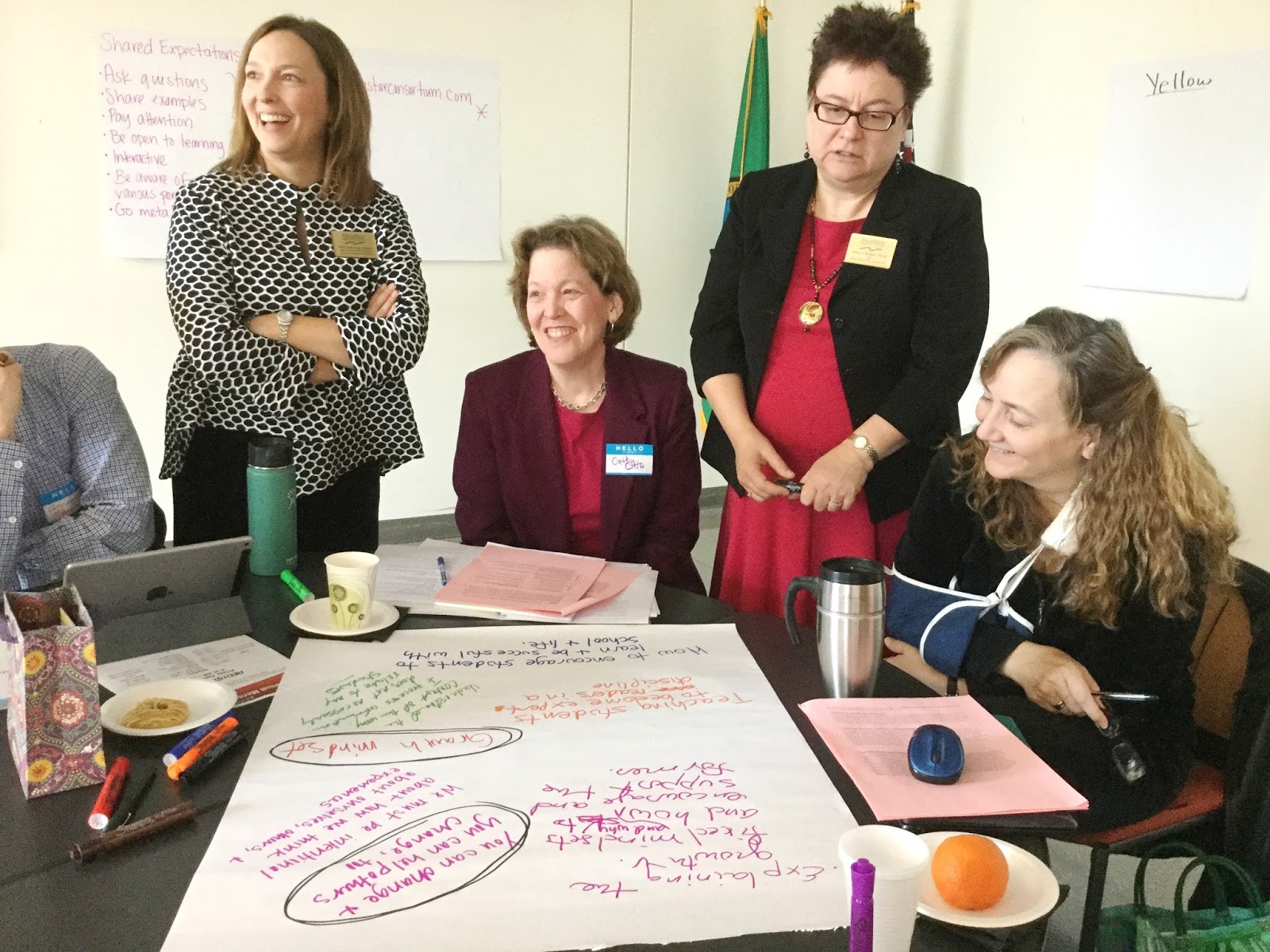
A few weeks ago, on March 18th, the 5-Star Consortium hosted a lunch-and-learn event for Deans at Shoreline Community College.
The goal of this event was for Deans and other administrators to know exactly what it is the 5-Star Consortium does for their faculty, and to have a taste of the experience. Approximately 25 people came together, shared ideas and left with a sense of accomplishment!
Here's what attendees are saying about the Deans event:
"The active learning was so well-done! Thank you!"
"I appreciated experiencing the various best practices."
"I really liked the interactivity and opportunity to get to know others. Learning from each other as well as from the facilitators."
"I was more engaged in learning about the HR policies, for example, because of the way it was done."
Deans can now tell new faculty the benefits of attending - helping them (especially brand new faculty) become aware of the college culture, learn teaching strategies that they can implement the next class, and network with other faculty from a variety of disciplines.
Thank you to all of the faculty developers, organizers and participants!
Stay tuned for more from the 5-Star Consortium!
The goal of this event was for Deans and other administrators to know exactly what it is the 5-Star Consortium does for their faculty, and to have a taste of the experience. Approximately 25 people came together, shared ideas and left with a sense of accomplishment!
Here's what attendees are saying about the Deans event:
"The active learning was so well-done! Thank you!"
"I appreciated experiencing the various best practices."
"I really liked the interactivity and opportunity to get to know others. Learning from each other as well as from the facilitators."
"I was more engaged in learning about the HR policies, for example, because of the way it was done."
Deans can now tell new faculty the benefits of attending - helping them (especially brand new faculty) become aware of the college culture, learn teaching strategies that they can implement the next class, and network with other faculty from a variety of disciplines.
Thank you to all of the faculty developers, organizers and participants!
Stay tuned for more from the 5-Star Consortium!
Wednesday, April 6, 2016
The Mentoring Conference at EvCC
Join us for the 1st Annual Mentoring Conference at Everett Community College!
Register today, or check out the EvCC Disruptive Innovation Website for more information & details!
Subscribe to:
Posts (Atom)