Showing posts with label deans. Show all posts

Monday, February 13, 2017

Evolution of My Syllabus

by Natasa Kesler, Director of the Teaching and Learning Academy at Cascadia College

A month or so ago, when our Deans suggested we organize a faculty workshop devoted to syllabus, my first thought was, “No one is coming to THAT!” My thinking quickly changed into an entrepreneurial, “How are we going to make that workshop attractive?” The preparation for the workshop made me think more deeply about my own syllabi over the years, and the story they told about my teaching. I soon determined there were three different stages of my syllabus evolution.

The first stage coincides with the beginning of my teaching career. As an inexperienced Biology instructor, I was grateful for those kind and generous colleagues who offered me their syllabi. Nothing sounded better than “Feel free to copy and paste anything you like!” That is exactly what I did - copied and pasted the whole thing, proudly remembering to insert my own name, email and phone number under “contact information." As a new instructor, my tendency was to worry not to “mess anything up” so I copy/pasted the offered syllabi and followed their lead.

Can you recollect the first syllabus you ever wrote? Did you have a better way of approaching your course materials when you were brand new to teaching?

As I continued teaching, these initial syllabi improved a bit each quarter; I added, subtracted, elaborated and corrected bits and pieces.

Once a tenure track faculty at Cascadia College, I entered my second stage of syllabus evolution. This time around I started from scratch and ended up with a syllabus that contained three parts: “must-haves”–  dictated by the institution, “could-haves” – generally recommended for the syllabus, and “junk”- stuff I believed I needed to make my syllabus stand out.

The “must-haves” are easily located at each institution. They range from course descriptions to syllabus learning agreements and usually contain very standardized language. I still copy/paste these.

Are you familiar with your school requirements regarding the syllabus?


The “could-haves” make up the majority of my syllabus and are the ones I spend considerable time creating. The most important parts of “could-haves” are probably:
  • What to expect in the classroom from your instructor
  • What your instructor expects from you
My promises and expectations change with different courses, student populations, and also change over time to reflect significant cultural trends, technology innovations, and so on...  What remains constant is my intent to make the list of promises to students very similar in length to the list of expectations I have from them.

Other examples that are definite “could-haves” are
  • Helpful tips and strategies
  • More detailed description of major assignments 
  • Grading policy and Course schedule
I find it advantageous to work out the detailed schedule for every class and lab session and to give elaborate and clear grading criteria.  Departing students often have to offer excellent syllabus improvement advice, making them an invaluable resources for keeping the “could-haves” section current.

What would you classify as “could-haves” in your syllabus? Do you have a strategy for changing /improving this section? Do you consider established best practices for syllabi?


You probably could not even imagine how cute, adorable, attractive, charming, simply irresistible (!) my early syllabi were! I had gorgeous figures and graphics depicting students, lab work, in addition to the most magnificent images of anatomical structures, dancing skeletons, Olympic athletes…did I mention it was all very colorful?!? I hoped that all of this fantastic imagery would evoke enthusiasm for my teaching and infuse excitement into traditionally very difficult subject.  Well, you can imagine my disappointment when I went to a workshop titled “How to make your syllabus accessible” and realized that my syllabus was 100% inaccessible! This is how I have come to the third stage of my syllabus evolution – the accessible syllabus!

For me, Accessibility and Universal Design for Learning is where most of the work remains, but changing my syllabus recently to make it more accessible has given me a good start, and prompted me to continue on this path of improvement.


Have you thought about issues of accessibility? Do you have a plan for making you syllabus/course accessible?

Friday, February 10, 2017

Reminder: 2nd Annual Disruptive Innovation Mentoring Conference

If you haven't already, check out what Everett Community College is planning with their annual Mentoring Conference!

The Conference will be held April 7, 2017. Details can be found at the above link.

Don't forget; Session Proposals are due next Monday, February 13th, 2017!

Questions? Email fivestarcolleges@gmail.com

Wednesday, February 8, 2017

Why Do We Need a Mentor?

By Peg Balachowski, Associate Dean for Teaching & Learning at EvCC 


Many of you reading this post will know that the term mentor comes from the ancient Greek story of Mentor, a friend of Odysseus, who was asked to be in charge of his son Telemachus when Odysseus left for the Trojan War. It seems the definition has not changed much – Dictionary.com defines a mentor as a “wise and trusted counselor or teacher.” Sounds just like what Odysseus was looking for regarding his son.
In my career I have had several mentors – both formal and informal, mentors who challenged me, motivated me, and encouraged me. The mentors that I have had over a long period of time have acted as a coach and in some cases a counselor. Today I want to say thank you to all those amazing people, to let them know that without them, my path would have been significantly different.

Here at Everett Community College, we want to highlight the work of all mentors. On April 7, 2017, we will be hosting our second annual Mentoring Conference. We believe that mentoring focuses on the future; the more successful our mentoring programs are, the more successful we will be as an institution.

Dr. Brandy Brown
This year our plenary speaker will be Dr. Brandy Brown from the University of Arizona South, a Hispanic-serving institution. Dr. Brown is an Industrial-Organizational Psychologist and assistant professor in Organizational Leadership. Through courses like Leadership in Diverse Environments and the undergraduate research lab that she co-created with Dr. Laura Lunsford, The Mentoring and Leadership Collaboratory, she demonstrates the value of mentoring as a tool to empower non-traditional and marginalized students and studies leadership education as well.

Presentation titles this year include: Reflective Practices in Mentor/Mentee Relationships, Engaging the Reluctant Mentee, Mentoring Inspired Supervision: A Model of Connected Experiential Learning, and many others.

Are you interested in learning more about our conference? Check out our webpage, and consider making a presentation on any of the mentoring themes for the conference. We hope to see you there!

Tuesday, January 31, 2017

Seeking Student Feedback

Seeking Student Feedback
by Peg Balachowski

I’ve been thinking a lot about student feedback lately, mostly because in Winter Quarter 2017, a cohort of 17 faculty at EvCC are using a new online tool called Instant Feedback to collect data on student learning. The questions all address an instructor’s pedagogy. Students are asked to describe the frequency of the instructors teaching practices in these areas:

•    Displayed a personal interest in you and your learning
•    Found ways to help you answer your own questions
•    Demonstrated the importance of the subject matter
•    Made it clear how each topic fit into the course
•    Explained course material clearly and concisely
•    Introduced stimulating ideas about the subject.

Each time the instructor uses the feedback session (4 times throughout the quarter) they will focus their attention on the area in which they scored the lowest. Faculty will then review white papers that address this area and describe why this topic is important and how to apply this technique in the classroom. After this they plan how to incorporate these new techniques in their class. The most important part of their work is to let students know that they heard what the students said, then tell them what will change based on their feedback. The hope is that whichever area the faculty member address they will see improvement in the next feedback session.

Why do this? Often we as faculty assume we know what students are thinking. This is especially true if we’ve been teaching for a while. I remember in a class thinking I knew what a student was asking before they even asked it! So why ask for honest feedback when it could be scary?

We know that by asking students how things are going in a class they begin to feel valued, and this results in more student engagement. They know their voice has been heard! As this engagement develops, you will likely have fewer classroom management issues.

And remember, this falls under the umbrella of formative assessment. Summative assessment, including exams and quizzes, doesn’t tell the whole story of a student’s progress. Based on the results of formative assessment, you can adjust your classroom practices to maximize student learning.

If you created a short survey to use as a formative assessment for student feedback, what are some good questions you might ask? Post your answers in the comments below, or email fivestarcolleges@gmail.com!


Wednesday, December 21, 2016

Making Your Classroom New Year’s Resolutions

Fall Quarter is over and done. Maybe it was a good one, or maybe it wasn’t so pretty. But it’s over. Time to reflect on the quarter and make some resolutions about what you’ll do in your classes in 2017. To help you get started, I’ll share some of my resolutions for 2017.

Resolution #1 – Listening with Intention

This is one of my resolutions that crosses over both my professional and personal life. Just before sitting down to write this blog post I had a meeting with a colleague. We decided to get away from our offices so agreed to meet at a nearby coffee shop. It was quite noisy (you know that sound that an espresso machine makes? It seemed to be amplified today!) which made it hard to listen carefully. But here’s an even bigger problem for me -I don’t know about you, but when I am having a conversation I tend to be thinking about my response even before the other person is finished talking. I’m sure I miss a lot of what the person is really trying to say, so I am going to practice looking at the person and focusing on them rather than my own responses. I have time to practice with family over the holiday, so I hope to come back to campus having sharpened this skill.

Can you see how this would be a good habit to work on in the classroom? I don’t think our students necessarily expect us to have an immediate answer to every question, so why not start a response with, “I like that question. Let’s unpack that some more.” That gives you a bit of “stall” time to formulate a response or to ask a clarifying question. Can’t tell you how many times I said to myself, “Oh, I’ve heard this question before” and my response was totally automatic. But sometimes I missed what the student was really asking so we had to start over again. Practicing listening with intention will be my homework over break.

Resolution #2 - Reflection

I think that building a practice of reflection is critical to good teaching and every aspect of my job. But how much time do I spend doing it, and how well do I do it? I bought myself a small notebook, and my second resolution is to make a note every day before I go home about something that happened that day. In fact, I am going to put this on my calendar so that I get a little reminder to do it!

What do I think the benefits will be and why do I think this is important? Terry Heick, founder and director of teachthought says that “reflection is a fundamental tenet of learning…to reflect means to look back at how something ‘went’ in all of its available parts and patterns.” What are those patterns? Strengths and weaknesses, comparisons and contrasts, and cause and effects among others.  Reflection will allow me to think about planning for the future (even if the future is as close as the next day) by reviewing the past. So my little black book will have a special place on my desk next quarter, and I am committing to writing every day about how at least one thing went.

Reflection #3 – Revision

I have been in my role as the Associate Dean of Teaching and Learning for 2 full years now. Most of you know that there is a steep learning curve when you start a new job, and because this is a newly created position, it seems like there is always more stuff that gets added to my position description. As it is, there are lots of moving parts, and as I begin every quarter it (almost) feels like a new job. But there are some activities or parts of my job that I feel like I have a good handle on now. So, do I just continue doing them in the same way for another year when things seem to be going well? I’m thinking about ways I can infuse some innovative practices into my work.

If you have been teaching the same class for a while, maybe it’s time to do some revision. While I do not recommend completely revising a class (especially only weeks from the beginning of a quarter), why not try a new assignment? Or introducing students to transparent rubrics if you have not been using them? Start small, and then measure the effects. If you use an assignment but create a new rubric, are you seeing an improvement in student grades and understanding of the material? Remember that revisions should not be taken lightly. They require substantial planning – even for something as “small” as a new assignment or rubric.

So if things don’t go well, reflect on what happened (see Resolution #2). Actually, even if things did go well, reflect on it! It could be that the assignment was a great one, but the directions were not clear. Ask students for feedback (using formative assessments) to help improve your work. And take a look back at September’s blog post, “What to do if you’re having an off day.” Learning from failure is an important task to master!

I hope that you had a great fall quarter, and are looking forward to the New Year, new classes, and new students. There is nothing more satisfying than the look on a student’s face when they begin to comprehend the material. I hope you have that experience many times in 2017!

- Peg Balachowski, Associate Dean of Teaching and Learning


Wednesday, October 19, 2016


Developing a sense of belonging in our classroom, on our campus

This past summer I was lucky enough to be a part of a team from Everett Community College that attended the first annual Teaching and Learning National Institute (TLNI) at Evergreen College in Olympia WA. From the very beginning our team used as a guiding principle three questions that we believe all students ask (regardless of their previous experiences with education) when they walk onto our campuses and into our classrooms for the first time: Can I do this? Is it relevant? And Do I belong here? Several of our plenary sessions at the TLNI actually addressed the importance of developing a sense of belonging, so we knew we were on the right track. Since EvCC is a Guided Pathways college, we are working hard to build persistence and belonging in our students, which we hope will lead to not only success but completion as well. We also believe that as students develop this sense of belonging, they will become more engaged. Belonging and engagement are different; a student can be engaged in a class without really feeling a sense of belonging.


As a group we also read a paper that was published by Don Wood and Gregory Williams from Odessa College in Odessa TX. Odessa College suffered one of the lowest retention/dropout rates in the state. After talking with faculty whose class retention rates were the highest at the college, the researchers noted that there was no consistency across what type of course (STEM vs Humanities, for example, where the STEM classes are perceived as being more difficult and would suggest a lower retention rate) and the type of pedagogy (lecture vs group or team learning, where lecture classes were thought to have a lower retention rate and group learning would suggest more student engagement and therefore a higher retention rate). But they found that there were inconsistencies in their hypotheses. So what was is that certain instructors – those with the highest retention rates – were doing? Don Wood told me it boiled down to four basic (and pretty simple) ideas that he called the 4 Commitments:
  • Interact with students by name from the first class,

  • Closely monitor student behavior and progress and intervene immediately if anything should go amiss,

  • Have one-on-one meetings with each student early in the semester to ensure a connection with the student is established, and

  • Become a “Master of Paradox” meaning develop highly structured courses with clear and understood penalties for missed exams, late assignments, etc., but be flexible with the penalty when appropriate.

When faculty began implementing this in their classes, retention began to improve across all disciplines and all instructors. Not only that, but many of the equity gaps began to disappear. Now Hispanic males began to succeed at the same rate as their white counterparts. We believe that by addressing the three questions above and implementing one or all of the 4 Commitments, we can help build those important relationships with students that are a part of developing a sense of belonging. Your Professional Development person on your campus can help you develop small changes in your classroom that will lead to greater student success and higher retention!

Want to know more about how to improve retention in your classes? Here are some of the references from Wood and Williams’ paper:

References

Dunwoody, P.T.  and Frank, M.L.  (1995) “Why Students Withdraw from Classes,” Journal of Psychology, 129(5), 553-558.

Harris, D. and Sass, T. (2009) “What makes for a good teacher and who can tell?”  National Center for the Analysis of Longitudinal Data in Education Research (CALDER). Working Paper #30. Washington, DC: Urban Institute.

Tinto, V. (1987) “The Principles of Effective Retention,” Paper presented at the Fall Conference of the Maryland College Personnel Association, Prince George’s Community College, Largo, MD.

Developing a sense of belonging in our classroom, on our campus

This past summer I was lucky enough to be a part of a team from Everett Community College that attended the first annual Teaching and Learning National Institute (TLNI) at Evergreen College in Olympia WA. From the very beginning our team used as a guiding principle three questions that we believe all students ask (regardless of their previous experiences with education) when they walk onto our campuses and into our classrooms for the first time: Can I do this? Is it relevant? And Do I belong here? Several of our plenary sessions at the TLNI actually addressed the importance of developing a sense of belonging, so we knew we were on the right track. Since EvCC is a Guided Pathways college, we are working hard to build persistence and belonging in our students, which we hope will lead to not only success but completion as well. We also believe that as students develop this sense of belonging, they will become more engaged. Belonging and engagement are different; a student can be engaged in a class without really feeling a sense of belonging.


As a group we also read a paper that was published by Don Wood and Gregory Williams from Odessa College in Odessa TX. Odessa College suffered one of the lowest retention/dropout rates in the state. After talking with faculty whose class retention rates were the highest at the college, the researchers noted that there was no consistency across what type of course (STEM vs Humanities, for example, where the STEM classes are perceived as being more difficult and would suggest a lower retention rate) and the type of pedagogy (lecture vs group or team learning, where lecture classes were thought to have a lower retention rate and group learning would suggest more student engagement and therefore a higher retention rate). But they found that there were inconsistencies in their hypotheses. So what was is that certain instructors – those with the highest retention rates – were doing? Don Wood told me it boiled down to four basic (and pretty simple) ideas that he called the 4 Commitments:
  • Interact with students by name from the first class,

  • Closely monitor student behavior and progress and intervene immediately if anything should go amiss,

  • Have one-on-one meetings with each student early in the semester to ensure a connection with the student is established, and

  • Become a “Master of Paradox” meaning develop highly structured courses with clear and understood penalties for missed exams, late assignments, etc., but be flexible with the penalty when appropriate.

When faculty began implementing this in their classes, retention began to improve across all disciplines and all instructors. Not only that, but many of the equity gaps began to disappear. Now Hispanic males began to succeed at the same rate as their white counterparts. We believe that by addressing the three questions above and implementing one or all of the 4 Commitments, we can help build those important relationships with students that are a part of developing a sense of belonging. Your Professional Development person on your campus can help you develop small changes in your classroom that will lead to greater student success and higher retention!

Want to know more about how to improve retention in your classes? Here are some of the references from Wood and Williams’ paper:

References

Dunwoody, P.T.  and Frank, M.L.  (1995) “Why Students Withdraw from Classes,” Journal of Psychology, 129(5), 553-558.

Harris, D. and Sass, T. (2009) “What makes for a good teacher and who can tell?”  National Center for the Analysis of Longitudinal Data in Education Research (CALDER). Working Paper #30. Washington, DC: Urban Institute.

Tinto, V. (1987) “The Principles of Effective Retention,” Paper presented at the Fall Conference of the Maryland College Personnel Association, Prince George’s Community College, Largo, MD.

Wednesday, September 21, 2016

What to Do if You’re Having an Off Day – Learning from Failure

Boy, oh boy. When I think back to my first year teaching (I was a new math teacher at a high school just outside Washington, D.C.), I wonder what kind of damage I might have inflicted on those students!! I was brand new to teaching, had just moved to the area and didn’t know anyone, and my daughter was just entering her teenage years – sounds like a recipe for disaster, doesn’t it? I had a mentor teacher from a different high school - and she was a wonderful mentor - but there were lots of days when I felt like a complete failure and just wanted to wallow in my own misery. Don’t get me wrong – there were good days, too! Seeing the light go on for students (remember, it’s math!) is what kept me going back everyday. So how did I learn to deal with those off days?

My mentor teacher gave me lots of hints. The first and most important was to learn from any perceived failures in class. I still use this lens when I have the opportunity to teach a class. Here are three recommendations from Josh Stock who wrote about failure in this article on the Edutopia website:

1. Before the lesson goes wrong, always have a backup plan. 

2. Ask yourself: "Why did that lesson fail?" 

3. Come up with a plan for the next day. 


Number 1 supports my recommendation of “over prepare” in case things do go wrong. Have short activities that you can insert which will bring things back together. Remember that formative assessments “take the temperature of the room,” and you should have a few “back pocket” techniques, as author James Lang calls them, that you can whip out and check on how things are going.

Numbers 2 and 3 fall into the category of reflecting on your practice. As Josh Stock says, “Having a bad lesson doesn’t make you a bad teacher. We all have off days. It’s what you do afterwards that makes the difference.” Bring mindfulness to your teaching and make room for reflection. This is where YOUR learning takes place. Even though at the end of the day there is grading and MORE planning to do, take several minutes to review what happened (or didn’t happen) in class. Were students not engaged? Were they not responding with correct answers? Did you get looks from them telling you they had no idea what was going on?

Sometimes it’s possible to recover during the class, but if not, at the end of class – in the last 5 minutes – ask

students to do a 5-minute write on the class. I like to raid the recycling bin and find all those rejects from the copy machine that are printed on just one side. I cut them in half and then have a stack in the classroom. Grab a couple and ask students to summarize the class as an “exit ticket.” You could ask something like, “What was the most important take-away for you today?” After class it’s important to read the responses (as much as you might not like the responses, students are EXCELLENT sources of data!) and then report back to students what you learned. Closing the feedback loop will let students know that you heard them and are truly interested in their learning. Tell them what will happen as a result of what you heard. You can begin the next class with, “looks like I need to review the quadratic equation today, so let’s begin with another example.” That tells students that this is an important topic and you are willing to spend a bit more time on it. Of course, it may be the case that the class wasn’t as bad a failure as you thought! Using a formative assessment like this helps students to be more reflective, too. A win-win all around!

Monday, July 25, 2016

Save the Date: Fall 2016 Best Practices in Active Learning and Student Engagement Event

While it's still warm outside and we're enjoying the beautiful Pacific Northwest Summer, it's already time to start thinking about and planning for Fall!

The 5 Star Consortium Colleges invite you to join us at our quarterly event this September!


If you're a New Associate Faculty member, you'll definitely want to mark this down on your calendar:


New Associate Faculty: Best Practices in Active Learning and Student Engagement

Saturday, September 24th, 2016 8am-12:30pm at Edmonds Community College
Gateway Hall 6600 196th St. SW Lynnwood, WA 98036

Stay tuned for more info!

Monday, April 11, 2016

Deans Event

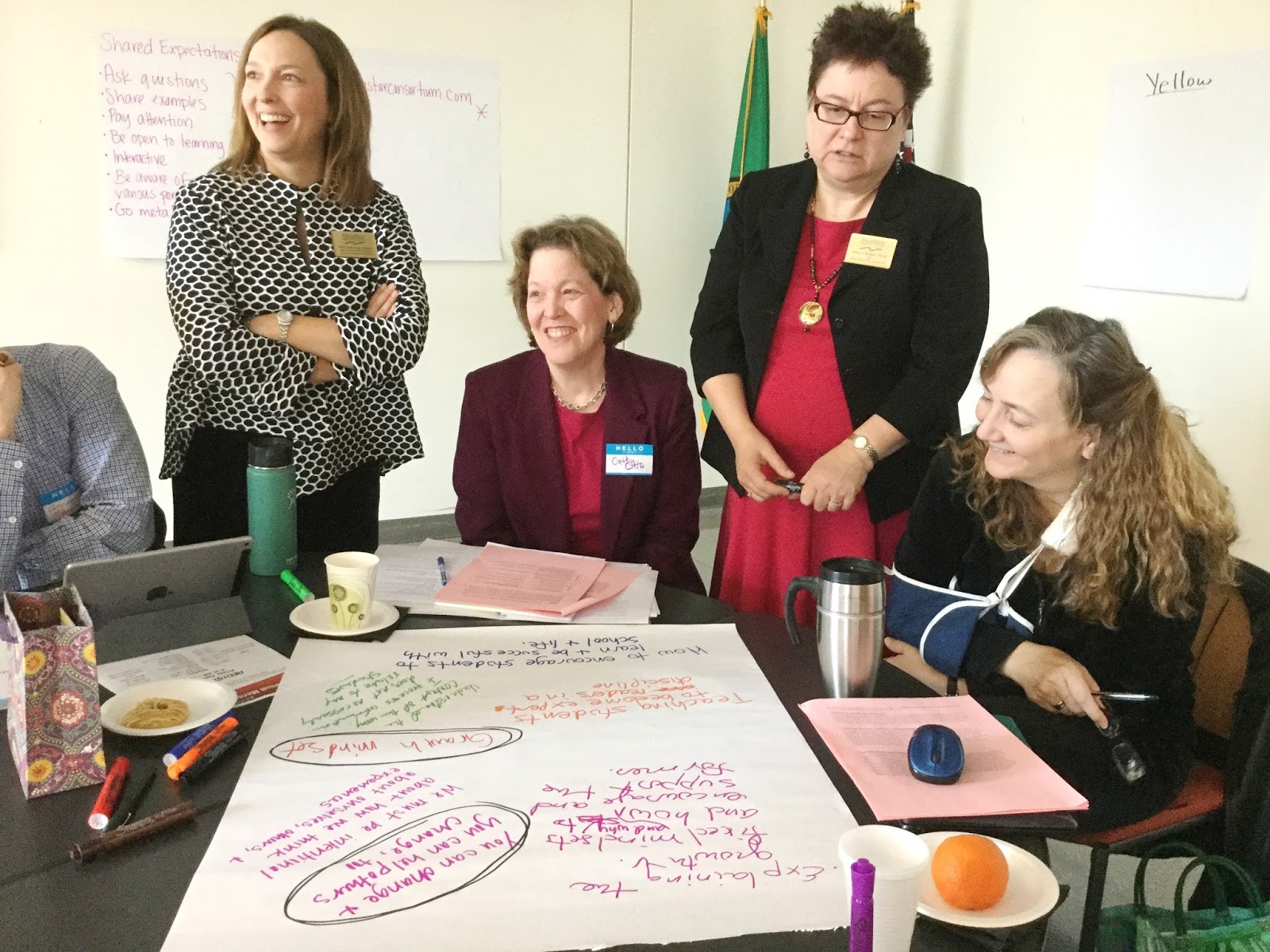
A few weeks ago, on March 18th, the 5-Star Consortium hosted a lunch-and-learn event for Deans at Shoreline Community College.

The goal of this event was for Deans and other administrators to know exactly what it is the 5-Star Consortium does for their faculty, and to have a taste of the experience. Approximately 25 people came together, shared ideas and left with a sense of accomplishment!


 Here's what attendees are saying about the Deans event:

"The active learning was so well-done! Thank you!"

"I appreciated experiencing the various best practices."
"I really liked the interactivity and opportunity to get to know others. Learning from each other as well as from the facilitators."

"I was more engaged in learning about the HR policies, for example, because of the way it was done."


Deans can now tell new faculty the benefits of attending - helping them (especially brand new faculty) become aware of the college culture, learn teaching strategies that they can implement the next class, and network with other faculty from a variety of disciplines.


Thank you to all of the faculty developers, organizers and participants!

Stay tuned for more from the 5-Star Consortium!